Some reminders for a more fulfilling life (while doing great work)
People call them by many names: principles, mantras, rules, mottos. Truths to act as guardrails when you are beginning something new and give you clarity when your mind feels clouded.
In the end days of 2020, I wrote a list of such things in my journal. While I wrote these as reminders to myself, I think they can be useful to you too, so I wanted to share them here with you.
Here they are...
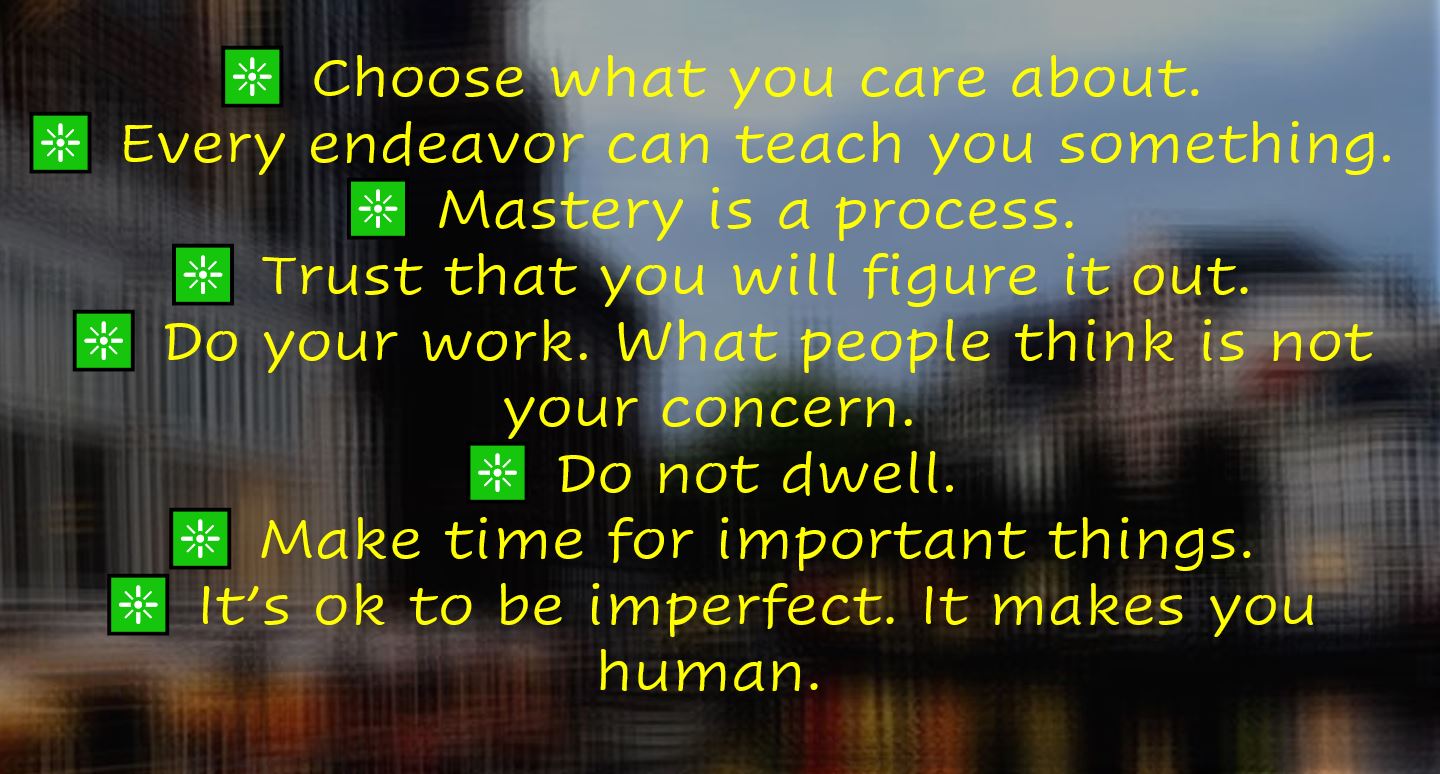
1. Choose what you care about.
Have you read this wonderful book "The Subtle Art of Not Giving a F*ck?" Don't be fooled by it's title. The book is not an argument for utter thoughtlessness about *everything* in your life. There are undoubtedly things that you should care about. For me - as 2020 made abundantly clear - these are my health, my significant relationships, and doing good work that matters. But we tend to care about too many things around us, and that's what the book preaches against.
Over the course of my life, I have learned to become choosier in this regard. I have learned to ask questions like: Does it really matter if a random co-worker doesn't like me? Why should I care what my aunt thinks about my life choices? Choose what you spend your mental calories on - it can free your mind.
2. Mastery is a process, not a state.
Many of us are in high-octane professions or have bold goals. Our work typically calls for a level of excellence that we are not born with. Becoming great at work will take time. I have told the story of my early days at Microsoft before. This process of "noticing my gaps -> learning -> getting feedback" is cyclical and has been ever-present in my career. Whether it is coding or leadership or speaking or writing, being at peace with not being an instant virtuoso has helped ease my mind.
3. Trust that you will figure it out.
In the summer of 2016, I decided to walk the Swiss Alps, from Chamonix to Zermatt, along a well-known path called the Haute Route. It took me about two weeks to walk the entire 100+ miles, scaling multiple passes.
It was one of most wondrous things I have ever done. Night skies strewn with a million stars, massive blue glaciers tumbled over mountainsides, rumbling waterfalls, forests thick with trees, and winds so strong they could push you down if you don't take care. The walk was also one of the most challenging things I have done, completely beyond my comfort zone.
When I decided to do it, I was beset by doubts. I wrote about one particularly dreadful section here. It was a goat path winding up a mountain that felt like a heap of rocks. With every step I took, my feet sank and slithered. But I did it, despite my self-doubts and fears. I watched where I planted my feet. I used rocks as leverage to pull myself up. It was slow going and nerve-wracking, but I figured it out.
It is the same deal with work. To do big, scary things - in life or work - you need to know deep down that you will figure it out.
4. Every endeavor can teach you something. Be curious.
It takes little experiments and baby steps to build that trust in yourself. When we build software products, in my team, we experiment a lot. We make little hypotheses and test them out. We learn. That is how we know when to build on and what to alter. Likewise, think of every activity you pursue - every interaction you have, every meeting you attend - as a little experiment that can help you learn something.
One of my mentors told me once to "collect data with every interaction". Approach your work with that scientist-like mindset and you will find that you look forward to many previously frightful activities.
5. Do not dwell.

In 2018, I was asked to demo a few Microsoft technologies to a packed arena of 20000+ IT Professionals. I had never done anything like that before, and understandably, I was nervous. My demo was 30 minutes long, split into two segments. I was in the middle of my second segment when I realized something was wrong with my demo. My prepared words were spilling out of my mouth, but what I expected on the screen didn't materialize. The product team had just deployed something that caused my script to become irrelevant. I stumbled.
Even today when I watch the video clip of it, I zero in on the part where I failed. When I got off the stage that day, feeling like a child who had just dropped her ice cream cone on dirt, I went straight to my team to say I was sorry. I had failed them. I had failed the demo. But my team didn't even notice my fumble. They thought everything had gone as planned. The moral: do not dwell on your screw-ups. Sure, failures are important learning opportunities, but there is no use in dwelling on what's happened. Besides, no one is intently watching *everything* you say and do. We are all too caught up in our own lives for that.
6. Do your work. The outcome and people's reactions are not your concern.
When I was growing up, my father often told me to do my best and leave the rest to God. I like a variation of that aphorism now: Do your work, do not burden yourself with the outcome. Focusing on my work - not on how it is received or how it is going to succeed or fail - has helped me not just be happier but produce higher quality work too. In fact, I do this a lot with my writing. I write because I enjoy writing, I have something to say, I have a right to say it, and I believe it will help others. What others think of what I say, whether they agree or not, whether it is well-received or not - these are not my concern.
7. Make time for important things.
First, make a list of things that are important to you - work, health, relationships, fun. Anything else you're doing that doesn't contribute to what is important to you - like binge watching that show on Netflix, doomscrolling through Twitter, gossiping with a relative - cut it from your life. We often feel like we do not have time to do everything. Here is the thing: you don't need to do everything you're doing today. If you are intentional about where you're spending your time, you will magically mine minutes throughout the day that you can use for important things in your life.
8. It's ok to be imperfect. It makes you human.

A very good friend of mine, who is a master storyteller, makes her slides the morning of her talk. She hates rehearsing. I, on the other hand, can overthink what I say and how I say it. I come from a long line of people who didn't like to "get laughed at" by their neighbors and family, so aiming for perfection is as easy as mixing salt and water to me. It is not just me, though. Many luminaries that I admire - from Melinda Gates to Angela Merkel to Michelle Obama - are famous over-preparers. Christine LaGarde, the president of European Central Bank once said this about her preparation.
When we work on a particular matter, we will work the file inside, outside, sideways, backwards, historically, genetically, and geographically. We want to be completely on top of everything, and we want to understand it all, and we don't want to be fooled by somebody else.
I have nothing against preparation. I continue to be someone who likes to prepare, especially for important meetings and events. But I also know that overpreparing can kill your ability to think on your feet. More importantly, it can make you anxious and lose valuable time. In the world of software development, we say that Done is better than perfect. It is true for life too. Remember that you are only human, and people know that. Most people are not expecting perfection from you.
So those are some of the things I intend to remind myself of often. The last days of 2020 were aimless and rainy where I live, dark clouds brooding over a titanium gray sky. As we left 2020 behind to start a fresh new year, it was the ideal moment to reflect on these important lessons. I think it can be mighty helpful for you to make a list of your own too - reflect on your experiences and tendencies you want to keep at bay, and write reminders for yourself. All you need are a notebook, a pen, and some quiet time.
Will you do it?